
Why Patient Advocacy Partnerships Matter in Rare Disease Research
For pharmaceutical and biotechnology companies, the success of any rare disease program—from clinical development to commercial launch—is inextricably linked to the patient community. Indeed, Patient Advocacy Groups (PAGs) are not merely stakeholders; they are the gatekeepers of access, the custodians of patient registries, and the essential voice representing the true burden and unmet need of a condition.
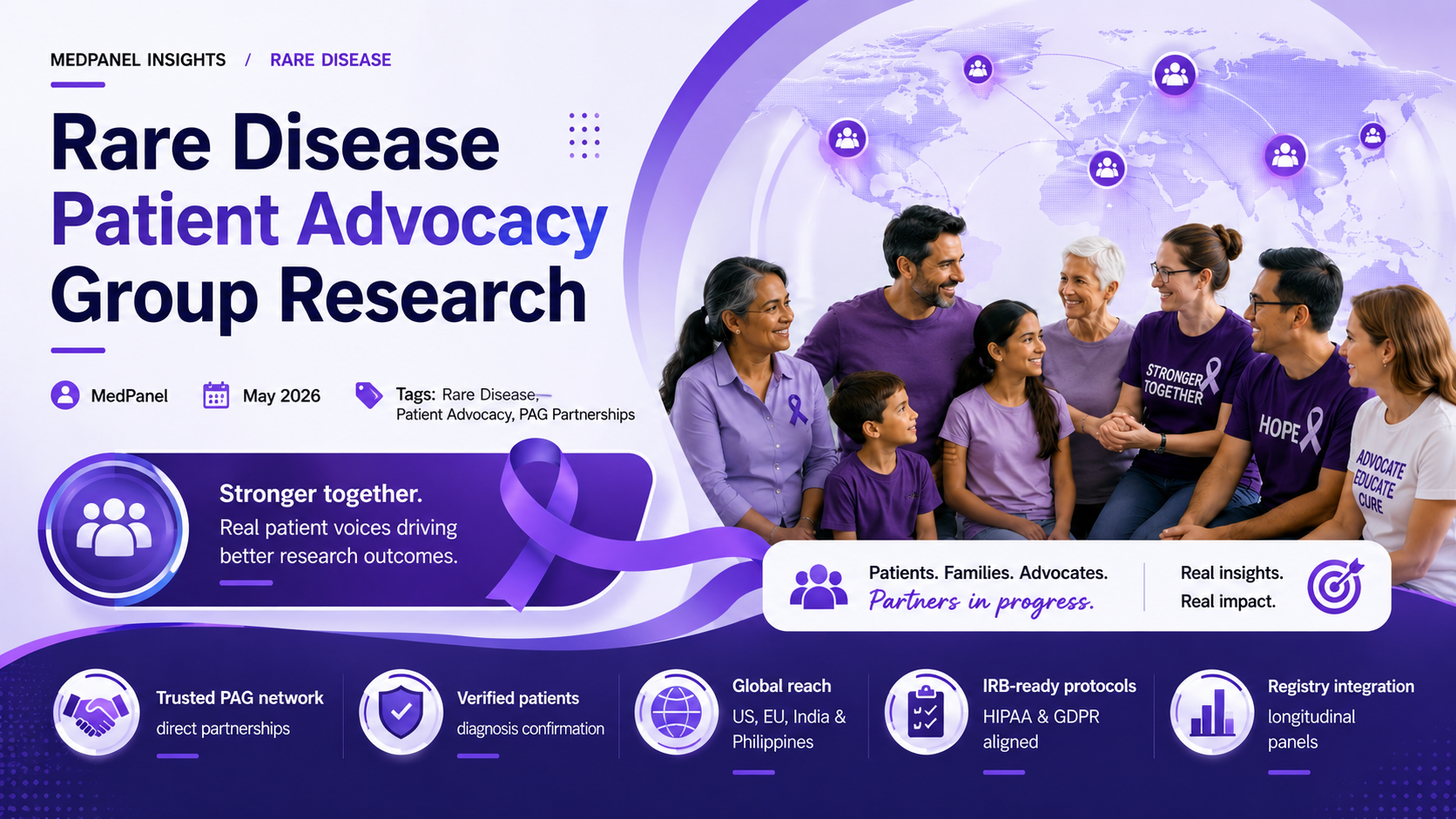
Moreover, partnering with these organizations requires sensitivity, deep therapeutic understanding, and a commitment to regulatory compliance that goes far beyond standard market research protocols. Specifically, MedPanel specializes in enabling high-trust, high-compliance rare disease patient advocacy research partnerships. Therefore, we provide the infrastructure, specialist expertise, and IRB-ready protocols that allow biopharma teams to ethically and effectively engage the most crucial, hardest-to-reach patient populations globally.
The Foundational Role of PAGs in Rare Disease Patient Identification and Community Access
The traditional methods of patient recruitment that work for common conditions fail completely in the rare disease landscape. For example, conditions affecting a small percentage of the population have no consumer-facing panels with meaningful reach, and diagnosis complexity means electronic records are often unreliable. As a result, this structural challenge elevates Patient Advocacy Groups to an indispensable role in patient identification and research access:
Community Custodianship
For many ultra-rare conditions, the PAG is the central hub for a globally dispersed patient population. Moreover, they maintain crucial communication channels—newsletters, support groups, patient conferences—that reach a diagnosed and engaged community in ways no general panel can.
Overcoming Scarcity
Where prevalence is low, active, targeted outreach through trusted community partnerships is necessary to reach diagnosed patients. In other words, database-driven recruitment alone is not viable.
Evidence Generation
PAGs are significant commissioners of market research themselves. Furthermore, they leverage patient burden studies, unmet need assessments, and caregiver studies to build the evidence base required for disease awareness campaigns, policy advocacy, and negotiations with pharmaceutical partners.
Ultimately, understanding and respecting the PAG’s role is the first step in a successful rare disease patient advocacy research partnership. Above all, MedPanel views PAGs as critical partners whose integrity and trust within the community must be preserved.
MedPanel’s Advocacy Network: How Partnerships Work and What They Deliver
MedPanel has cultivated an extensive network of direct, trusted relationships with patient advocacy organizations and disease-specific foundations across a wide range of therapeutic areas, from rare hematologic disorders to ultra-rare metabolic conditions. In particular, our partnership model is built on transparency, mutual respect, and a shared goal of accelerating research velocity while prioritizing patient welfare.
Our Partnership Approach:
Direct Engagement
First, we engage PAGs directly as recruitment partners, integrating their deep community knowledge with our research execution capabilities.
Recruitment Engine
Additionally, our sourcing model combines proprietary, client-built rare disease assets (such as our flagship Hemophilia database built over 30 years) with partner-enabled recruitment through PAGs, disease foundations, and specialist referral networks.
High-Fidelity Delivery
Partnerships are study-driven and designed to deliver fresh, diagnosis-confirmation-required patients, ensuring the data is of the highest quality for high-stakes decisions. In addition, we handle all screening, verification, and quality control, presenting the PAG with a compliant, ethical, and valuable engagement opportunity for their members.
What These Partnerships Deliver to Biopharma:
Verified Patient Recruitment
Access to patients who are clinically verified eliminates the high screen-failure rates and unqualified responses endemic to self-reported panels. As a result, you receive data that reflects genuine clinical or lived experience.
Accelerated Timelines
For conditions where international reach is mandatory to achieve adequate sample sizes, our global patient recruitment infrastructure and PAG partnerships enable compliant, multi-country fieldwork. Consequently, teams can move faster without compromising quality.
Representative Samples
Notably, PAGs help ensure samples are representative of the true patient population, including those on a diagnostic odyssey or using alternative nomenclature for their condition, who are often missed by standard screeners.
Consent and Privacy: HIPAA, GDPR, and Informed Consent Alignment
Working with patient data, especially for vulnerable populations, requires an uncompromising commitment to regulatory compliance and ethical research practices. Therefore, MedPanel’s infrastructure is built to de-risk client programs from a privacy and compliance perspective, making every study IRB-ready from the outset.
IRB-Ready Protocols from Day One
Every MedPanel study involving patient or caregiver engagement is pre-designed to meet Institutional Review Board (IRB) submission requirements. Moreover, our team includes compliance professionals experienced in rare disease research ethics, ensuring your protocols withstand scrutiny from legal teams and ethics boards alike.
Global Data Privacy
Rare disease studies frequently require accessing patients across North America and Europe to achieve feasibility. Furthermore, our infrastructure and protocols are aligned with key global data protection regulations, including HIPAA for US-based research and GDPR for multi-country European patient studies.
Validated Informed Consent
In addition, we deploy rigorous, validated informed consent protocols. Importantly, this is crucial for protecting participants’ welfare and maintaining the high level of trust established through our PAG partners, preventing participant fatigue in communities that are frequently over-researched.
Patient Registry Integration and Longitudinal Panel Building
Patient registries, often managed by PAGs or academic centers, represent a fundamental asset for rare disease research. In practice, MedPanel works with PAGs to ethically integrate registry access into research programs, providing a foundation for both single-point-in-time studies and long-term research needs.
Registry Utilization
Leveraging condition-specific registries allows us to precisely identify and segment patients based on criteria beyond simple diagnosis, such as disease severity, time since diagnosis, or specific treatment experience. As a result, limited recruitment resources are focused on the most relevant cohorts.
Longitudinal Panel Building
The stable, verified nature of the PAG network and registry access enables the creation of longitudinal panels. In particular, this is vital for programs that require repeated data collection over extended periods—for tracking disease progression, monitoring treatment pattern shifts, validating patient-reported outcomes (PROs), or conducting observational research.
Data Integrity
Our approach ensures that data collected from integrated sources is subject to the same strict verification and compliance standards as all MedPanel research. Therefore, biopharma clients gain high data confidence as they navigate the rigorous evidentiary requirements of HTA bodies and regulators.
MedPanel’s Competitive Differentiation: The Verified Foundation for Rare Disease Research
MedPanel’s capacity to execute complex rare disease patient advocacy research partnerships is built on four core, structural advantages that differentiate us from generalist vendors:
Verified Panel (Not Self-Reported)
Specifically, we mandate diagnosis confirmation across all patient studies, ensuring that respondents reflect genuine clinical experience and are not noise from unverified sources.
Global Reach in Rare Disease
For instance, our global recruitment infrastructure, with active teams and partners in the United States, Europe, India, and the Philippines, is essential for reaching the critical mass of patients and specialists required for ultra-rare conditions.
IRB-Ready Specialists
Notably, our research designers and project managers work exclusively in rare and specialty disease, understanding the therapeutic context and recruitment constraints. Consequently, every patient protocol is designed from day one to meet IRB submission requirements, accelerating time-to-field.
Rare Disease Focus
Above all, we are a specialist firm. Indeed, our deep experience is concentrated in complex, hard-to-find patient populations, combining research through Patient Advocacy Groups and physician referral networks with full-service research execution at speed and scale.
Initiate Your Advocacy Partnership Enquiry
If your biopharma team is ready to move beyond generalized panels and establish a compliant, high-integrity rare disease patient advocacy research partnership, MedPanel is ready to help. Therefore, our specialists ensure your engagement is ethical, effective, and delivers the verified insights necessary to advance your program.
Finally, contact our dedicated partnership team today to discuss your study objectives, or learn more about our foundational rare disease market research services. Specifically, to submit a brief directly, email info@medpanel.com with the subject line “Advocacy Partnership Inquiry.”